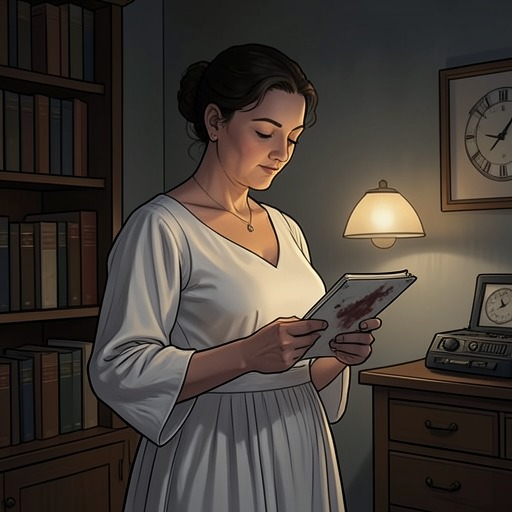
Daisy's songbook
Daisy Jones & the SixDaisy's songbook is the growing collection of song sketches through which Daisy Jones pursued authorship on her own terms. It began with pen and paper, without musical training, and eventually held rough sketches of more than a hundred songs. Its importance lies not in a claim that every entry was finished or recorded, but in the tension it makes visible: Daisy had abundant ideas and a strong desire to write, while the work of completing songs remained unfinished.
Origins and Ambition
Daisy began writing songs because she wanted to make a name for herself outside the Sunset Strip. The songbook took shape before she had formal musical training; its earliest defining feature was not polish but abundance. More than a hundred rough sketches accumulated in it, evidence of a sustained impulse to make material of her own rather than depend on other people's words.
That aim distinguished songwriting from singing for Daisy. At a recording session at Larrabee Sound, she rejected Hank Allen's request that she sing a demo more smoothly and at a higher key, leaving rather than adjust her performance as he wanted. She later described caring most about songwriting and wanting to sing her own material. The songbook gave that ambition a physical form, even as her early record deal did not guarantee that the songs in it would be recorded.
The Runner Records Rejection
When Runner Records held a kickoff meeting, Simone Jackson helped Daisy prepare by going through the songbook with her. At the meeting, Daisy brought out one song after another, but the representatives did not select any of them to record. They considered the songs not ready and Daisy not ready as a songwriter. The rejection exposed the gap between the volume of her work and the label's judgment of what could be made into a record.
Daisy's response was not simply disappointment at a single decision. She was flipping through the entire book at the conference table, worried that the representatives had not properly read it, while they continued to say the songs were not ready. Afterward, Simone found Daisy drunk in the bathtub and stayed to get her safely into bed once she had passed out. Daisy went back to her own place the following morning, tried to put the meeting out of mind, and used cigarettes and drugs while Hank attempted to calm her. The songbook, so recently prepared as the center of a professional opportunity, had become the focus of a painful judgment on her work.
From Sketches to Craft
In 1974, Daisy was refusing to attend recording sessions at the Record Plant in West Hollywood and was in breach of her contract with Runner Records. This context underscores that the songbook alone could not resolve the conflict between her wish to create and the demands of a recording career. Her work habits also limited what the collection could become: she later recognized that she often followed a loose melody with lyrics, then moved on after one or two rounds of work. The book held promising lines, but not necessarily songs developed from beginning to end.
Teddy Price challenged her insistence on ideal conditions for making art. Daisy initially shut the door on him, but later opened the songbook and reconsidered his criticism. She saw that she had strong lines without fully polished songs, and recognized that wanting a writing career would require more sustained effort. A few days later, she agreed to record an album with Teddy. His response—that it was her album—helped her see that a record could still belong to her even if it did not match her original vision exactly. The evidence does not establish that the album consisted of songs taken from the songbook; rather, her reassessment marks a change in how she approached the labor the book represented.
Meaning and Legacy
The songbook's arc is therefore not a simple progression from notebook to finished record. At first, its scale—over a hundred rough sketches—expresses creative possibility. At the Runner Records meeting, the same collection becomes the object through which Daisy encounters institutional rejection. Later, rereading it allows her to see both the promise and the incompleteness of her work. Its pages do not make the songs finished by themselves; they reveal the need for revision that Daisy had resisted.
Daisy released her debut album, First, at the beginning of 1975, after deciding to work with Teddy. The available account connects that release to her growing willingness to work through the process of making an album, but does not identify the songbook as the source of its tracks. Its significance is instead as a record of the ambition and unfinished labor behind Daisy's pursuit of songwriting: a private collection that repeatedly meets the standards of a label, a producer, and Daisy herself.